There was a time when an ordinary person knew how to do an extraordinary number of things. Not because they were unusually talented, but because they had to. Someone in the family knew how to repair an engine. Someone could preserve food. Someone knew which plants would grow in the local soil and when to put them in the ground. People could sew, sharpen a blade, build a fence, clean a fish, repair a leaking pipe, identify trees, start a fire, make bread, navigate without a glowing blue dot, and keep old machines alive years after the manufacturer thought they should have been replaced.
They weren’t survivalists. They were just people, and much of what they knew was never written down. It lived in their hands.
A grandfather showed his son how to hold the tool… A mother showed her daughter how to recognize when the dough was ready by touching it… A neighbor leaned over an engine and said, “Listen to that”… A child followed an adult into the woods and slowly learned that a forest wasn’t just a wall of green. It was oak and maple and cedar, tracks and nests, seasons and weather, things you could eat and things you absolutely should not.
Knowledge moved from person to person. Then something changed.
We became incredibly good at making things easier, and in many ways that was wonderful. Machines took over exhausting work. Stores made necessities available year-round. Specialists became accessible. Technology put nearly the entire accumulated knowledge of humanity within reach of a device in our pockets. But convenience came with a trade.
Every time we handed something over, we stopped needing to know how to do it ourselves, and when knowledge is no longer necessary, it has a strange habit of disappearing.
It doesn’t disappear all at once. One person stops teaching it… Another never learns… Someone else remembers watching his father do it but can’t quite remember how…
Then one day an entire family possesses a skill only as a memory: “My grandfather used to know how to do that.”
That sentence should bother us more than it does, because civilizations don’t only lose knowledge when libraries burn. Sometimes they lose it quietly, one funeral at a time.
Think about the oldest person in your family and everything stored inside that person’s head. There may be recipes that were never measured, stories nobody recorded, ways of repairing things that aren’t manufactured anymore, knowledge about a piece of land, family history, fishing holes, gardening tricks, tools whose names the younger generation may not even recognize, songs, crafts, techniques, mistakes, and lessons learned the expensive way.
Now imagine all of it disappearing. There is no explosion, no catastrophe and no dramatic final scene.
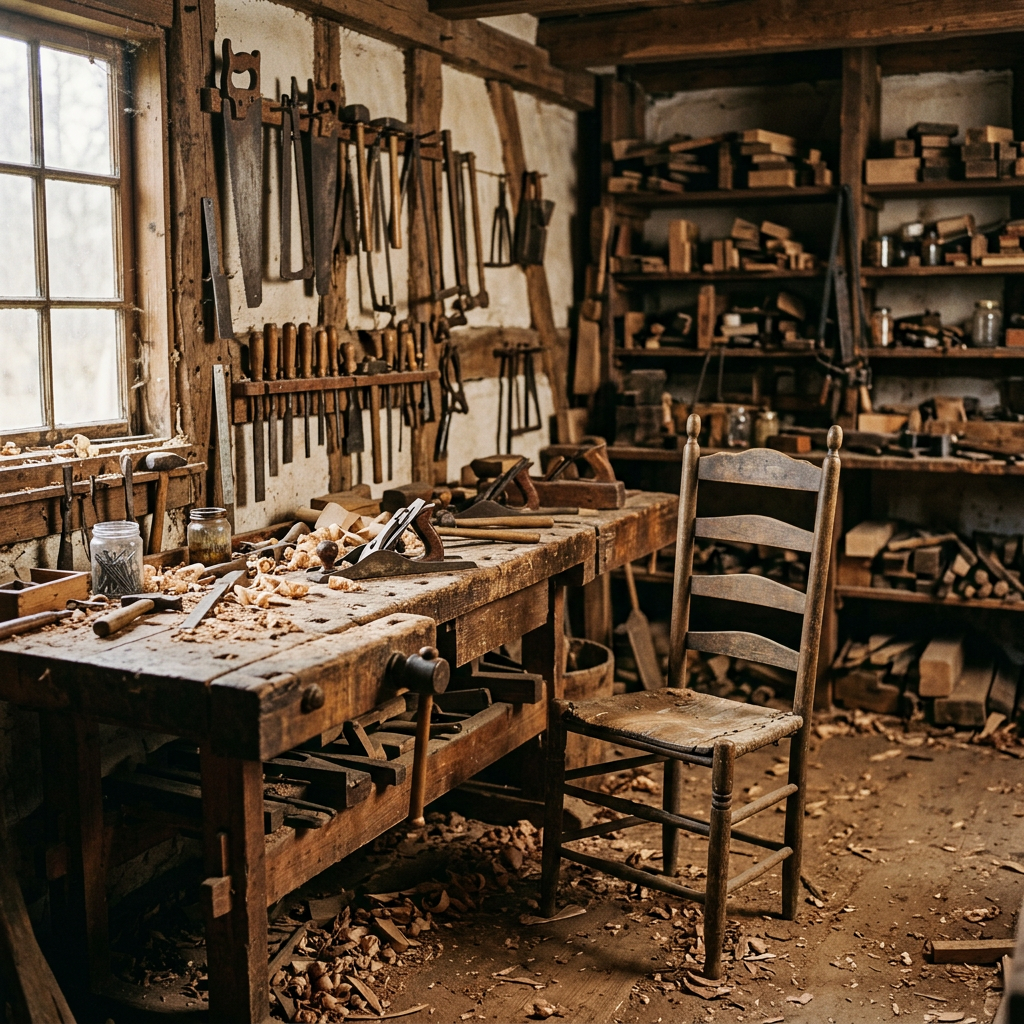
There is simply an empty chair, and suddenly everyone realizes nobody ever asked.
We tend to think humanity’s knowledge is safely stored because the internet exists, but information and knowledge are not the same thing. You can watch fifty videos about woodworking and still not know what a sharp chisel feels like when it moves correctly through grain. You can read about fishing for a month and learn more in one morning beside someone who has fished that lake for forty years. You can download a thousand recipes and still wish you had written down the one your grandmother made from memory.
Some knowledge can be digitized. Some has to be transferred from hand to hand, person to person, generation to generation. We are running an enormous experiment in what happens when that chain is broken.
Children now have access to more information than kings and scholars possessed for most of human history, but access is not inheritance. A search engine can tell you how to plant a tomato. It cannot give you the childhood memory of following your grandfather through the garden while he explains why this particular corner gets planted later because the frost settles there. Those are different kinds of knowledge. One answers a question. The other gives you roots.
Perhaps that’s what we’re actually in danger of losing. Not merely skills, but connection.
The workshop was never only about woodworking. The kitchen was never only about food. The boat was never only about fishing, the garden was never only about vegetables, and the garage was never only about fixing the car. Those places were classrooms disguised as ordinary life.
A child stood beside an adult and learned how to hold the flashlight…tie the knot…knead the dough…drive the nail…or turn the wrench. At the same time, something else was being transferred: patience, stories, standards, humor, failure, confidence, identity, and the quiet knowledge that this is what my people know how to do. That’s difficult to replace with a tutorial.
None of this means we should reject technology. Quite the opposite. For the first time in history, we have the ability to preserve and share human knowledge on a scale our ancestors couldn’t have imagined. A retired carpenter can teach someone thousands of miles away. A grandmother can preserve a recipe for descendants she may never meet. A person learning to garden can ask someone who has been doing it for fifty years. A dying craft can find new students, and a forgotten hobby can become someone’s obsession.
The technology that helped interrupt some of these old chains of knowledge may also give us the greatest opportunity we’ve ever had to rebuild them, but only if we decide the knowledge is worth saving.
We spend enormous amounts of time preserving things that won’t matter: posts, arguments, trends, celebrity gossip, whatever the internet is angry about this afternoon. Meanwhile, somewhere today, someone who knows something remarkable is getting older. Maybe nobody has asked them to teach it. Maybe they don’t even realize what they know is valuable. Somewhere else, someone younger is staring at a screen thinking, I wish somebody could show me how to do that.
Those two people should be able to find each other.
That’s part of the reason Hobbies & Homes exists. I don’t want it to become another website endlessly producing things to scroll past. I want to build a place where knowledge survives because people share it, where someone who has spent forty years woodworking can help someone making their first crooked shelf, and where hunters, gardeners, artists, collectors, fishermen, craftsmen, hikers, builders, restorers, cooks, makers and people who simply know things can leave something behind for the next person.
I want it to be a place where curiosity is rewarded, where people make things again, and where old skills find new hands. Because maybe the most important question isn’t whether humanity will continue creating more information. Of course we will. The question is whether we will remember to pass along the things that cannot be downloaded.
So ask someone. Ask your father, your mother, your grandparents, the old guy who somehow knows how to fix everything, the woman whose recipe everyone requests but nobody has ever written down, the neighbor with the incredible garden, or the craftsman whose hands make something difficult look effortless. Ask them to show you.
And if you’re the person who knows something, don’t assume nobody cares. Show somebody. Teach the kid standing nearby. Write it down. Take the picture. Tell the story. Pass it on.
Civilization has always been only one generation away from forgetting something, and somewhere in the world right now, a person is carrying the last living memory of how something is done.
We should find them before the chair is empty.


Leave a Reply